Getting there and what you pay
Himchari National Park sits about 12 kilometres south of Cox's Bazar town on the Marine Drive, the coast road that runs toward Teknaf. From the main hotel strip at Kolatoli or Sugandha, a CNG auto-rickshaw takes roughly 25 to 35 minutes depending on traffic through Jhilongja and the Kalatali stretch. Expect to pay 400–600 taka ($3.60–$5.40) each way for the whole vehicle; a shared local bus or tempo costs 30–50 taka ($0.27–$0.45) per person but drops you on the highway, leaving a short walk or another short ride to the gate. If you are coming from Inani or Himchari's own beach cottages, you are already close — under 10 minutes.
The entry fee is 50 taka ($0.45) per person for Bangladeshi nationals and 500 taka ($4.50) for foreign visitors. Parking for a private car is another 100 taka ($0.90). The gate opens around 8am and closes at sunset, roughly 5:30pm in winter and 6:30pm in summer. Bring cash — there is no card machine, and the nearest reliable ATM is back in Cox's Bazar town. Do not count on the ticket counter having change for a 1,000-taka note; carry small bills.
My call: skip the shared tempo if you are a group of three or more — the CNG is barely more expensive per head and saves you the highway walk. Do buy the ticket at the gate; there is no online booking and touts outside sometimes offer 'entry' that is really just a parking pass. Keep your ticket — staff occasionally check it at the waterfall trailhead.
The waterfall: when it runs, and when it does not
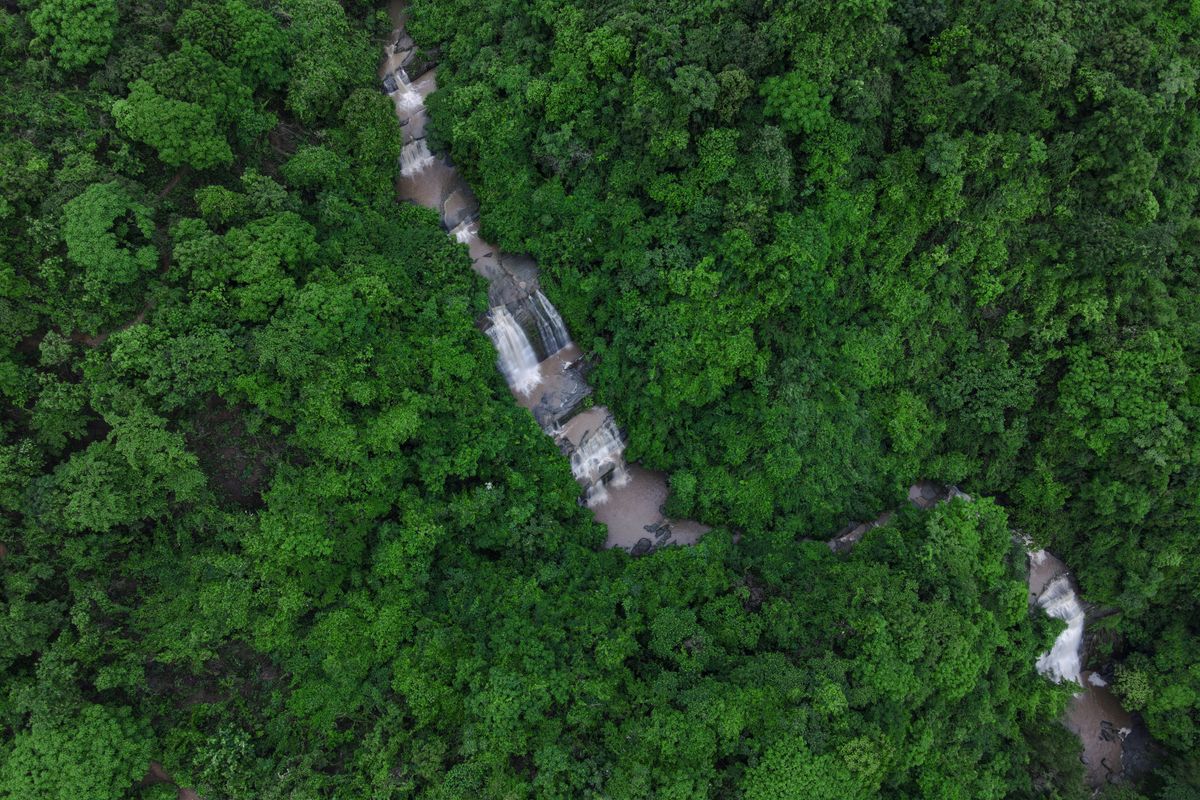
The truth about Himchari's waterfall is that for much of the year it is not a waterfall. It is a seasonal cascade fed by monsoon runoff from the low hills behind the park. It flows properly from roughly June to September, after the heavy rains, when a white ribbon drops maybe 10–15 metres into a small rocky pool. In those months it is genuinely pretty, loud enough to hear from the path, and the surrounding forest is green and dripping. From November through April — the dry season, which is exactly when most foreign tourists visit — the flow reduces to a trickle, and by February or March you may find only damp rock and a puddle.
Because of that, do not build your day around swimming in a plunge pool. There is no proper pool, no lifeguard, and the rocks are slick. Local visitors wade at the base during monsoon, but I would not. The path to the falls from the main park area is short, maybe 10 minutes on foot, but it is uneven and can be muddy. Wear shoes with grip, not flip-flops. The Forest Department does not maintain railings along the whole route, so watch children closely near the wet stones.
What I would do: if seeing an actual waterfall matters to you, come between late June and early September and accept that it may rain on you. If you are here in the dry season, treat the falls as a five-minute curiosity on the way to the viewpoint, not the main event. Skip the 'waterfall' entirely if you have mobility issues — the trail is not worth the risk when there is barely any water. The forest walk itself, with its stands of tall garjan and the chance of a kingfisher or a langur, is the better dry-season reason to be here.
The hilltop viewpoint: what you actually see
The paved path and a set of steps climb from the park's lower area to a ridge-top viewpoint. It is not a long hike — 15 to 20 minutes at an easy pace, maybe 500 metres of walking with some elevation. At the top you get a wide, open look south along the coast: the curve of Himchari beach below, the Marine Drive threading between hills and sea, and on a clear day the lighthouse at Teknaf is a faint speck far down the coast, roughly 30 kilometres away as the crow flies but over an hour by road. To the east, low green hills fold into each other. There is a small shelter and a few benches, but no café and no water vendor at the top.
The view is genuinely good, but it is not the impossibly dramatic panorama that some social media posts suggest. There is no infinity pool, no glass skywalk, no cable car. It is a seaside hill with a concrete platform, and the experience depends heavily on weather. On a hazy or overcast day — common from December to February — the long view flattens and the sea and sky blur into grey. Come early, ideally by 9am, for the clearest light and the coolest climb. Midday sun on the bare steps is punishing.
My verdict: the viewpoint is worth the climb and the small effort, but go for the coastal perspective rather than a thrill. I would skip the paid 'telescope' some local operators set up near the top in peak season; it is a tube on a tripod and rarely aligned. Bring your own water, because there is none for sale up there, and take your rubbish back down — bins are scarce and the monkeys will investigate anything left out.
Fridays and holidays: how busy it really gets
Friday is the weekly holiday in Bangladesh, and Himchari on a Friday is a different place. From about 10am the gate area fills with buses and private cars from Cox's Bazar town and, in winter, from Chittagong and Dhaka. The path to the falls and the steps to the viewpoint become a slow-moving queue. By noon the small parking area is full and vehicles line the Marine Drive. If you are driving yourself, arrive before 9am or after 3pm, or you will spend more time waiting for a parking spot than enjoying the park. Saturday, now also part of the weekend for many offices, is nearly as busy.
Peak crush comes during the winter season from November to February, and especially over three-day weekends and public holidays such as Eid. On those days the ticket queue alone can take 20 minutes. Foreign visitors sometimes get waved to a separate counter, but do not count on it. The forest is small enough that a few hundred people feel like a lot. If you want quiet, come on a Monday or Tuesday morning in the dry season — you may have the viewpoint almost to yourself.
What I would do: avoid Friday entirely if you value calm, and absolutely avoid it on a long weekend. If Friday is your only free day, come at opening time, do the viewpoint first while it is cool, then the falls, and leave by 11am as the crowds arrive. Skip the beach immediately below the park on Friday afternoon — it is the busiest stretch of the Himchari shoreline, and the litter builds up faster than it is cleared.
What else is around, and how to combine it
Himchari's own beach is a few minutes' walk from the park gate, reached by a short path under the trees. It is narrower and rockier than Cox's Bazar's main beach, with scattered boulders and a stronger current in places. Swimming is not advisable except in the calmest shallow edges, and there are no lifeguards. The beach is at its best early morning, before the day-trippers arrive. Combine the park with this beach rather than treating them as separate trips, since you have already paid for the ride down.
Most visitors pair Himchari with Inani Beach, a further 12–15 kilometres south on the Marine Drive, about 25 minutes by car. Inani has a longer, cleaner stretch of sand and several simple seafood restaurants, though prices are tourist-pitched — expect 300–600 taka ($2.70–$5.40) for a plate of grilled fish. Going the other way, back toward Cox's Bazar, you pass the Burmese market area and the turnoff for Radiant Fish World, a small aquarium that is fine for children on a rainy day. None of these require advance booking.
My plan: do Himchari in the morning, from 8:30 to 11am, then drive on to Inani for lunch and a late-afternoon beach walk, returning to Cox's Bazar before dark. Skip the roadside souvenir stalls just outside the park gate — the shell jewellery and dried fish are cheaper and better at the main Burmese market in town. And skip any 'guide' who approaches you in the car park; the paths are short and clearly marked, so you do not need one.
Practical notes for a conservative coast
Cox's Bazar is a conservative Muslim-majority area, and Himchari is a family destination, not a party spot. Dress modestly — shorts and bikinis are not appropriate away from the hotel pool areas, and you will be more comfortable in light trousers or a long skirt and a shirt that covers your shoulders. There is almost no licensed alcohol anywhere in Cox's Bazar district, so do not plan an evening drink around the park. Friday prayers around midday mean some local shops and eateries near the gate close briefly, though the park itself stays open.
Food options at Himchari are limited to a few basic shacks selling tea, bottled water, samosas and occasionally fried fish. Prices are 20–80 taka ($0.18–$0.72) for snacks. There are public toilets near the gate but they are basic; the cleanest facilities are at the larger restaurants back in Cox's Bazar town or at Inani. Mobile data coverage is patchy in the park, so download any maps or tickets you need before you leave town. The nearest hospital is in Cox's Bazar town, roughly 25 minutes away by road.
What I would do: wear covered clothing, carry small cash, pack out your litter, and keep expectations realistic. Himchari is a pleasant half-day in a low-key coastal forest, not a theme park. Go early, go on a weekday if you can, check the season before you expect a waterfall, and treat the viewpoint as the reliable highlight. That is the honest version, and it is still a good morning out.
Questions, answered
Hotels in Cox’s Bazar
See all stays →Curated picks are coming — meanwhile, the live search covers every bookable property at the same price or better.